
Indonesia is among countries with high level of air pollution, where PM2.5 concentrations exceeding the World Health Organization (WHO) recommended limits.
Pekanbaru, as the capital city of Riau Province is one of the city who burden the health, financial, and environment impact of air pollution due to forest fire. Strengthening institutional capacity for faster response during periods of hazardous air quality is crucial to lower the burden of these impacts. A need for development of Early Warning System is becoming more urgent in order to prepare a more proper and effective response.
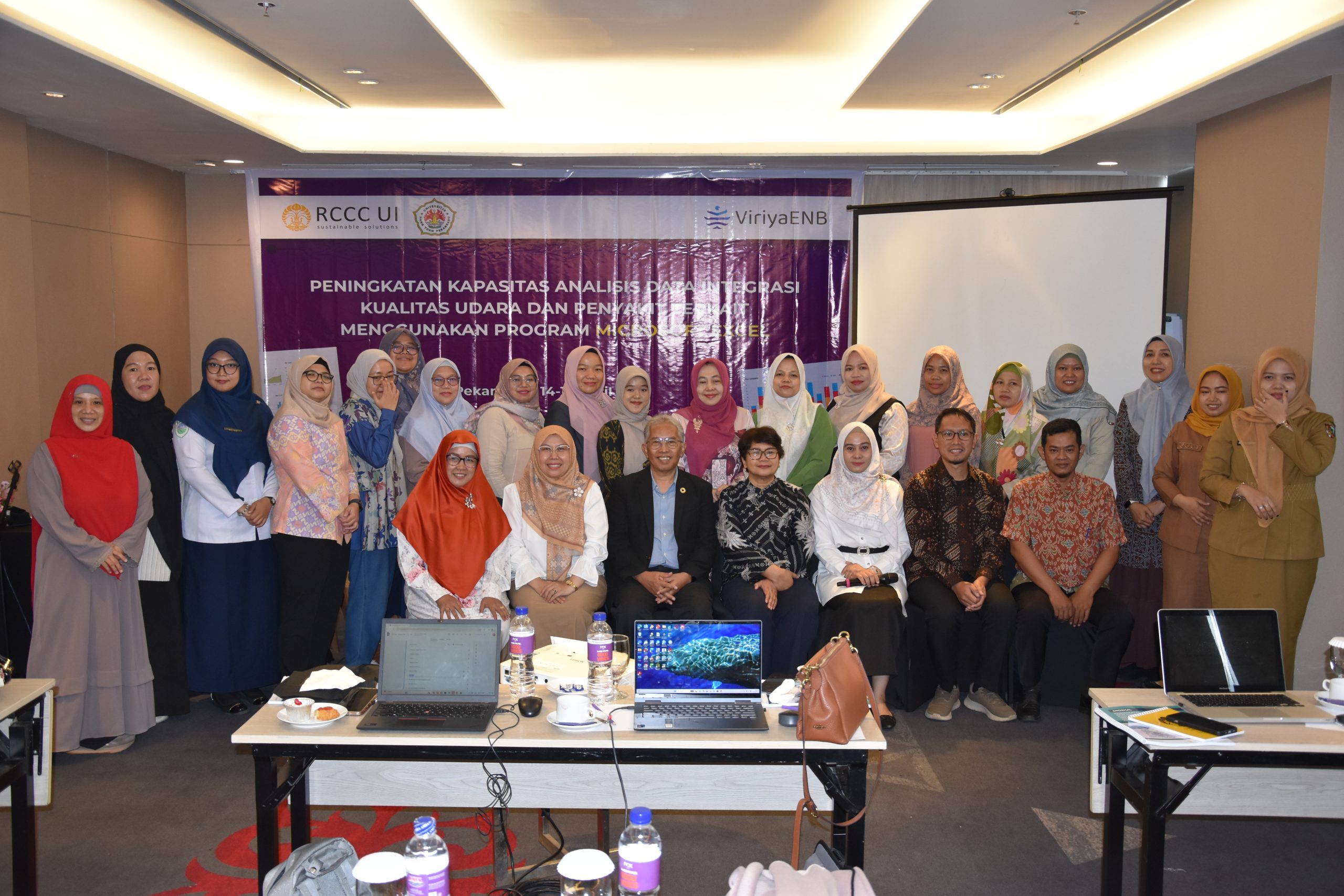
As part of this effort, the Research Centre for Climate Change, Universitas Indonesia (RCCC UI), in collaboration with the Master’s Program in Public Health, Universitas Hang Tuah, organized a capacity-building training titled:
Capacity Building on Integrated Data Analysis for Air Quality and Related Diseases Using Microsoft Excel, held in Pekanbaru in 14-15 April 2026.
This two days training is a continuation of RCCC UI previous effort held in Jakarta, Bandung, and Surabaya. We aimed to strengthen participants from academic institutions and government bodies’ skills in integrating and analyzing air quality and disease-related health data, while also fostering coordination and a shared understanding among institutions involved to support the development of effective early warning systems.
Throughout the training, participants developed practical skills in data processing and integration, including data cleaning and transformation, as well as identification of outliers. The sessions also covered basic statistical analysis using Microsoft Excel, such as normality testing (Kolmogorov–Smirnov and Shapiro–Wilk), correlation analysis (Spearman’s Rank and Pearson), simple regression analysis, and basic health data projection. Finally, we explained data visualization and interpretation techniques were also emphasized, enabling participants to produce meaningful charts, trendlines, and analytical outputs to support evidence-based decision-making.
We hope this collaborative effort with our partner from Universitas Hang Tuah Pekanbaru encourage fellow colleagues from academic institutions and local agencies for the development of data integration, thus lead to the build of early warning system, and eventually, improving air quality in Indonesia.
